Progressive Response Automation: A Practical Maturity Model for Security Teams
Move security playbooks from alerts to controlled automation with clear ownership, observable decisions, reversible actions, and promotion criteria defined by your own environment.
Treat security response automation as an operating discipline, not a switch. The question is not whether a team is "manual" or "autonomous." The useful question is: which actions can this team trust, under which conditions, with which safeguards?
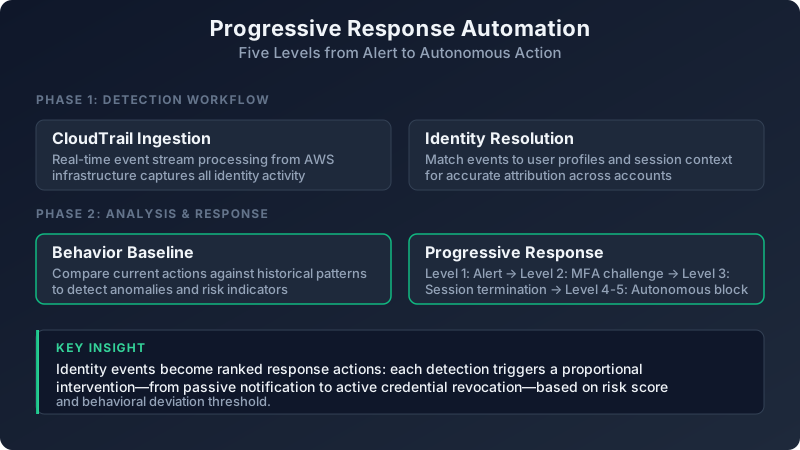
Use the maturity model below to decide what each playbook may do. Assign each playbook independently. A well-understood session-containment action may run automatically while a permission change remains approval-gated. A new detection can begin in observation mode without forcing mature playbooks back to manual handling.
This guide lays out five levels, from alert-only operations to bounded autonomy. It also explains what to measure, how to design rollback, and how to decide whether a response should advance, remain in place, or step back.
The Model at a Glance
| Level | System behavior | Human role | Evidence to collect |
|---|---|---|---|
| Observe | Creates an alert and records supporting events | Investigates and decides | Alert quality, disposition, investigation effort |
| Guide | Assembles context and proposes investigation steps | Reviews evidence and reaches a decision | Missing context, edited steps, decision rationale |
| Approve | Recommends a pre-approved response | Confirms or rejects the action | Approval, rejection, override reason, action result |
| Act with oversight | Executes a bounded, reversible action under policy | Reviews the notification and can reverse or pause | Policy match, action result, rollback, operational impact |
| Bounded autonomy | Runs a narrow playbook within explicit limits | Governs policy, exceptions, and periodic review | Drift, exceptions, blast radius, demotion triggers |
The level belongs to the playbook, not the program. Avoid applying one maturity label to an entire SOC. That framing hides the differences between response actions and encourages teams to automate high-risk decisions just to claim a milestone.
AWS and NIST both frame incident response around prepared, repeatable processes that connect detection, analysis, containment, recovery, and learning [1][2]. AWS also recommends documenting playbook prerequisites, owners, response steps, and expected outcomes [3]. Its operational guidance distinguishes investigation playbooks from the runbooks used to mitigate an issue [4]. CISA's response playbooks add useful coordination and tracking patterns [5], while AWS guidance on maturing automation emphasizes stabilizing procedures and retaining human interaction before automating triggers [6].
Choose the First Playbook Carefully
Begin with a response that your team already performs consistently. A useful first candidate has these characteristics:
- The triggering condition can be described in plain language.
- The evidence needed for a decision is available to the workflow.
- The action affects a narrow, known scope.
- The action can be reversed or allowed to expire.
- A team owns the playbook and can pause it.
- The result can be verified after execution.
Credential reauthentication, temporary session restriction, or routing an identity for additional review can be easier starting points than deleting an account or rewriting a broad policy. The goal is to learn how the workflow behaves in your environment while keeping operational consequences contained.
Write a response contract before building automation. The contract should name the trigger, required evidence, allowed action, excluded resources, owner, approval mode, verification step, rollback method, and pause condition. This document becomes the shared reference for security, identity, platform, and application teams.
The Five Levels
Level One: Observe
At the Observe level, the system creates a signal and preserves the evidence available at detection time. An analyst investigates, decides whether action is needed, and records the disposition.
This level is appropriate for a new rule, an unfamiliar identity pattern, or a response with unclear operational impact. It is also where the team learns whether the signal maps to a decision that can be described consistently.
Capture more than a closed-alert label. Record which evidence the analyst used, which systems they consulted, what action they considered, why they chose or rejected it, and who owned the affected resource. Those details reveal whether a playbook is repeatable.
Move forward when the team can explain the decision path, assemble the required evidence, and identify a bounded response. If analysts reach different conclusions from the same evidence, improve the detection or decision policy before adding automation.
Level Two: Guide
At the Guide level, the workflow gathers context and presents a structured investigation. For an identity alert, that context might include the principal, session, recent activity, resource ownership, permission changes, and related alerts. The analyst still decides what happened and what to do.
Treat analyst edits as product feedback. A frequently added query indicates missing context. A skipped step may be irrelevant, poorly ordered, or hard to interpret. An escalation to another team may reveal that ownership data belongs in the workflow.
The output should help the reviewer answer a small set of questions:
- What changed from the identity's expected behavior?
- Which resources and sessions are in scope?
- Is the activity consistent with an approved change or workflow?
- What action would contain risk without creating unnecessary disruption?
- How will the team verify and, if needed, reverse that action?
Move forward when the guided investigation is stable enough to support a specific recommendation. Keep the workflow at this level if the evidence is incomplete or the decision still depends on undocumented institutional knowledge.
Level Three: Approve
At the Approve level, the system recommends an action from an approved catalog, explains why the playbook matched, and waits for a reviewer. The reviewer can approve, reject, or modify the recommendation.
The approval screen should show the decision inputs, proposed scope, expected operational effect, verification step, and rollback path. A button without context turns human review into a rubber stamp. A useful approval creates a durable record of what the reviewer knew and why the action was allowed.
Track rejected recommendations and post-action reversals by playbook. Group the reasons: incomplete evidence, known maintenance, incorrect ownership, excessive scope, or a response that does not fit the resource. This is the training set for policy improvement, but it is also an operational audit trail.
Move forward when the team trusts both the recommendation and the action mechanics. Confidence in detection alone is not enough. The execution path, notification, verification, and rollback must work together.
Level Four: Act with Oversight
At the Act with Oversight level, policy authorizes the system to execute a bounded response as soon as its conditions are met. The workflow records the evidence, applies the action, verifies the result, and notifies the responsible team. Operators can pause the playbook and reverse the action when the response contract allows it.
Use policy boundaries that are easy to inspect. Scope them by action type, environment, resource owner, identity class, and change window. Exclude sensitive systems until their owners approve a response path and participate in testing.
An action should stop when a required input is missing, the proposed scope exceeds the contract, a dependency cannot confirm execution, or the playbook encounters an unrecognized state. These are normal control decisions, not automation failures.
Move forward only for playbooks whose decision quality and operational effect remain dependable across the conditions the policy covers. A playbook can stay at this level indefinitely; human visibility is valuable even when automated execution is stable.
Level Five: Bounded Autonomy
At the Bounded Autonomy level, a narrowly defined playbook detects, evaluates, acts, verifies, and closes the loop within its approved boundaries. People govern the policy rather than approving individual executions.
Bounded autonomy is not permission for a system to improvise across the environment. It is a precise contract for a known response. The workflow should expose why it ran, which inputs it used, what it changed, what verification returned, and whether any exception occurred.
Keep destructive or difficult-to-recover actions behind human review. Autonomy is most useful for time-sensitive actions that limit exposure while preserving options for responders. Permanent deletion and broad permission changes deserve a different control path.
Bounded autonomy also needs a clear route back. New application behavior, identity changes, data-quality issues, or unexpected operator interventions can all justify demotion. Moving a playbook to a lower level is evidence that governance is working.
Build Metrics from Your Own Baseline
No universal threshold can determine whether your playbook is ready. Risk tolerance, identity design, application criticality, and response mechanics differ by environment. Establish a baseline in observation and approval modes, then define promotion criteria with the teams that own the affected systems.
Use a scorecard for each playbook:
| Measure | What it tells you | Review question |
|---|---|---|
| Confirmed-action rate | Whether the recommendation matches the final analyst decision | Are rejected recommendations clustered around a correctable condition? |
| Operator intervention | How often people pause, modify, or reverse the workflow | Does intervention reveal policy drift or missing context? |
| Decision and containment time | Where the response process waits | Which handoff or evidence lookup creates delay? |
| Rollback frequency and effort | Whether actions are dependable and recoverable | Can the team restore service with the documented procedure? |
| Blast radius | How much of the environment an action can affect | Is scope known before execution and verified afterward? |
| Evidence completeness | Whether the decision record supports review | Can another analyst reconstruct why the playbook ran? |
| Coverage | Which relevant events are eligible for the playbook | Are exclusions intentional, owned, and reviewed? |
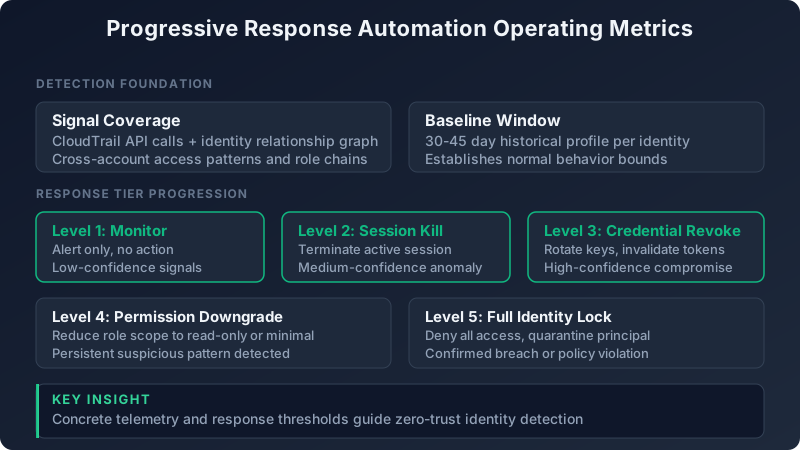
Review distributions and exceptions, not just aggregate summaries. A playbook can look healthy overall while one identity class or application repeatedly needs intervention. Segment results by environment, resource owner, action type, and detection path so the team can tighten the policy without hiding local risk.
Design Rollback Before Execution
Rollback starts with state capture. Before an action runs, record the relevant configuration, identity state, policy version, and ownership context. Give the response an idempotency key so retries do not apply the same change twice. Verify both the initial action and any reversal.
A practical rollback design answers these questions:
- What exact state must be preserved before execution?
- Can the original state be restored, or does recovery require a replacement?
- Who can trigger recovery?
- Which dependencies must be available?
- How will the system confirm that access and service behavior are restored?
- Which event pauses future executions of the playbook?
Test the reversal path with the same care as the forward action. An untested rollback note is documentation, not a recovery control.
Walk Through an Identity Response
Consider an alert for an identity using a sensitive permission from an unfamiliar context. The progression could look like this:
- Observe: capture the session, principal, permission, resource, recent changes, and owner; let the analyst decide.
- Guide: assemble related identity activity and present the team's investigation checklist.
- Approve: recommend a temporary, scoped containment action and wait for the reviewer.
- Act with oversight: apply that same action when policy conditions match, then notify, verify, and preserve rollback controls.
- Bounded autonomy: let the established playbook complete within its approved scope while the team reviews exceptions and policy health.
The action does not need to become more destructive as the playbook matures. Maturity comes from clearer evidence, better controls, and reliable operations. A temporary restriction can remain the right automated response at every level while investigators decide on permanent remediation.
Run a Promotion Review
Bring security operations, identity, platform, and application owners into the decision. Review the playbook's evidence rather than a platform-wide maturity label.
Ask:
- Is the trigger specific enough to support this action?
- Are the decision inputs complete and understandable?
- Does the policy exclude resources that need a different response?
- Is the action limited, verifiable, and recoverable?
- Have owners practiced the pause and rollback paths?
- Which conditions cause automatic suspension or demotion?
- Who reviews exceptions and approves policy changes?
Record the decision and its assumptions. When an assumption changes, the team should know which playbooks need another review.
Start with One Response Contract
Choose one frequent response that has a known owner and a safe containment path. Document the contract, observe how analysts decide, and improve the evidence before expanding automation. Let that playbook advance only as far as your own operational data supports.
Progressive response automation is valuable because it separates urgency from recklessness. Teams can shorten avoidable handoffs for understood events while preserving human judgment for ambiguous, broad, or irreversible decisions. The result is not automation for its own sake. It is a response system whose authority grows with evidence and contracts when conditions change.
References
[1] NIST, "Incident Response Recommendations and Considerations for Cybersecurity Risk Management." https://csrc.nist.gov/pubs/sp/800/61/r3/final
[2] AWS, "Incident response: AWS Cloud Adoption Framework Security Perspective." https://docs.aws.amazon.com/whitepapers/latest/aws-caf-security-perspective/incident-response.html
[3] AWS Well-Architected Framework, "Develop and test security incident response playbooks." https://docs.aws.amazon.com/wellarchitected/latest/framework/sec_incident_response_playbooks.html
[4] AWS Well-Architected Framework, "Use playbooks to investigate issues." https://docs.aws.amazon.com/wellarchitected/latest/framework/ops_ready_to_support_use_playbooks.html
[5] CISA, "Federal Government Cybersecurity Incident and Vulnerability Response Playbooks." https://www.cisa.gov/sites/default/files/publications/Federal_Government_Cybersecurity_Incident_and_Vulnerability_Response_Playbooks_508C_1.pdf
[6] AWS, "Create incident response playbooks, and build automation as your security response matures." https://docs.aws.amazon.com/whitepapers/latest/securing-iot-with-aws/create-incident-response-playbooks.html